
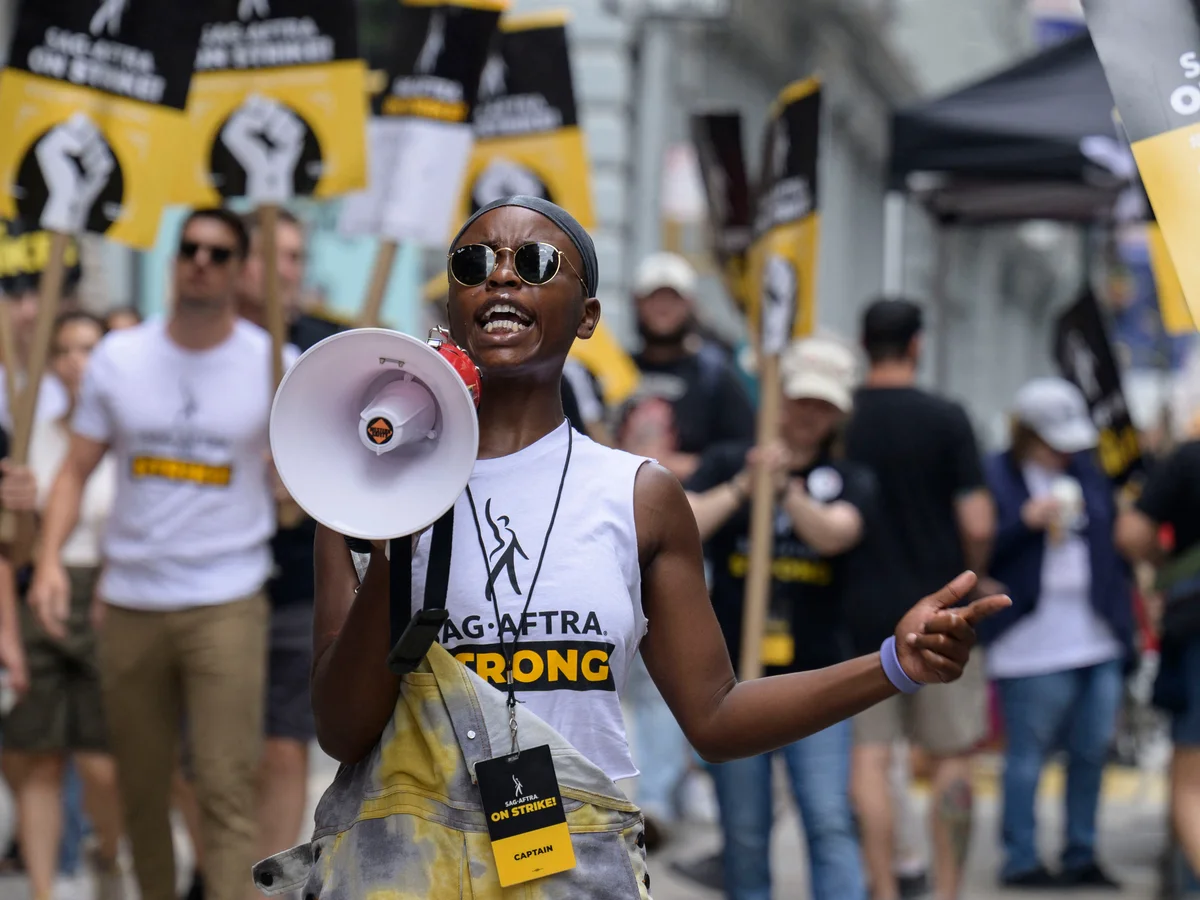


In the summer of 2023, Hollywood ground to a halt. For the first time since 1960, the Writers Guild of America and the Screen Actors Guild-American Federation of Television and Radio Artists were on strike simultaneously, and the promotional machine that normally propels a studio tentpole from soundstage to box office suddenly seized up. Red carpets emptied. Press junkets were cancelled. The famous faces that studios rely on to sell their films were, by union rule, forbidden from saying a single promotional word.
Into that vacuum stepped a different kind of celebrity: the social-media creator. As studios scrambled to keep marketing momentum alive without their contracted stars, some turned to TikTokers and Instagram influencers, offering them substantial sums to attend premieres, post sponsored content, and generate the kind of buzz that A-listers were no longer permitted to provide. The result was one of the strangest and most revealing chapters of the 2023 labor disputes, one that pitted the economics of the creator economy against the solidarity of the picket line.
Two Strikes, One Shutdown
The 2023 Hollywood labor disruption unfolded in two overlapping waves. The Writers Guild of America walked out first, beginning its strike on May 2, 2023, over disputes about streaming residuals, minimum staffing, and the emerging threat of artificial intelligence. That strike would last 148 days, finally ending on September 27, 2023.
The far more visible blow came on July 14, 2023, when SAG-AFTRA, which represents roughly 160,000 performers and media professionals, joined the writers on the picket line. It marked the first time in more than six decades that both guilds struck at once, and the actors’ strike proved lengthy in its own right, running 118 days until it ended at 12:01 a.m. on November 9, 2023. Members ratified their new three-year contract on December 5, 2023, with 78.33 percent approval.
For the studios, the actors’ walkout was uniquely painful on the marketing front. SAG-AFTRA’s strike rules barred members from any promotional activity tied to struck productions. Actors could not attend film premieres, sit for press junkets, appear at fan events including San Diego Comic-Con, or post about their projects on social media. The consequences were immediate and public. When the actors’ strike began, the cast of Christopher Nolan’s Oppenheimer, including Cillian Murphy, Emily Blunt, Matt Damon, and Florence Pugh, walked out of the film’s London premiere to honor the newly declared action.
A Marketing Machine Without Its Stars
The timing could not have been worse for studios. Summer is the industry’s most lucrative theatrical window, and 2023 was crowded with major releases: Warner Bros.’ Barbie, Universal’s Oppenheimer, Disney’s Haunted Mansion, and Warner Bros.’ Meg 2: The Trench, among others. These films had been built around the assumption that their casts would spend the summer barnstorming talk shows, walking carpets, and flooding social feeds. Overnight, that assumption collapsed.

Studios still needed to sell tickets, and they still had marketing budgets to spend. With their own talent sidelined, some looked to a workforce that existed largely outside the guild structure: social-media influencers. Creators with hundreds of thousands or millions of followers could, in theory, replicate the reach of a red-carpet appearance, posting from premieres, filming “get ready with me” videos themed around a film, or simply amplifying a trailer to an engaged audience. Crucially, most influencers were not SAG-AFTRA members, which meant the union’s strike rules did not automatically apply to them in the same way.
The Money on the Table
Reporting from the period documented that the sums offered to creators were far from trivial. According to Time, one creator described being offered between $3,000 and $10,000 per partnership for entertainment-related promotional work, while the influencer Ellen Orsi said she was offered $5,000 to promote what she described as a “household name movie franchise.”
Other figures ran higher. As Forbes reported, the Canadian creator Darcy Michael said he turned down a $25,000 sponsored deal, telling his team, “We’re not crossing picket lines.” The creator Erin Orsi (posting as @f0r3st.witch) said she rejected a $5,000 offer to promote a major film brand, explaining that she did not want to be “blacklisted from any future union activities or productions.”
The films at the center of these offers were among the summer’s biggest. Creators reported being approached to promote Barbie (Warner Bros. Discovery), Haunted Mansion (Disney), and Meg 2: The Trench. The lifestyle creator Courtney Quinn, who posts as @colormecourtney, said she cancelled 15 pre-shot promotional posts and videos for Barbie out of strike solidarity, and even changed her birthday party theme. The TikTok creator Bobbi Miller, who has more than 400,000 followers, said she had been invited to premieres for Spider-Man: Across the Spider-Verse and Barbie, and offered sponsored posts for the Apple TV+ series The Crowded Room and the Peacock series Mrs. Davis, but declined, calling the idea of crossing the picket line “very gross.”

Where the Union Drew the Line
SAG-AFTRA moved quickly to address the influencer question, recognizing that a parallel workforce could undermine the strike’s leverage. The union issued guidance clarifying that creators who wanted to preserve any path into the guild could not perform promotional work for struck companies.
As reported by Deadline, the union’s position was blunt: “Any non-member seeking future membership in SAG-AFTRA who performs covered work or services for a struck company during the strike will not be admitted into membership in SAG-AFTRA.” In other words, a creator who took a studio’s money to promote a struck film could be permanently barred from ever joining the union, foreclosing a career in acting or broadcasting down the line.
The guidance did carve out exceptions. Influencers already under contract to promote struck work before the strike could fulfill those existing obligations. But the union discouraged all voluntary promotional activity, advising creators to avoid posting about struck projects “whether they are posting organically or in a paid capacity,” and it explicitly prohibited participation in studio-sponsored activities at events like Comic-Con, including panels and meet-and-greets tied to struck properties. At the same time, the union clarified that creators remained free to pursue brand partnerships and commercial work unrelated to the struck studios, meaning the creator economy did not shut down wholesale.
“Scabbing” in the Age of TikTok
The controversy quickly acquired a loaded vocabulary. To cross a picket line in labor terms is to “scab,” and that word migrated onto social media with force. Creators who appeared willing to take studio money faced swift and public backlash from their own audiences, many of whom were sympathetic to the striking performers.
The most cited example was Juju Green, the creator known as Straw Hat Goofy, who has millions of followers. Green posted content suggesting he would continue promoting struck studios’ work, then faced intense criticism and deleted the video, later apologizing and calling his original comments “tone deaf.” As Time reported, he subsequently reconsidered his relationship to union membership altogether.
Working actors and writers pressed the case directly to creators. Franchesca Ramsey, a member of both SAG-AFTRA and the WGA, put it starkly: “If you are a content creator with aspirations to become an actor or writer, now is not the time to take a job because the rest of us are on strike. It will hurt your career.”
The episode exposed a genuine identity crisis within the creator economy. Some influencers, like Sidney Raskind, who has more than four million TikTok followers, chose to join SAG-AFTRA outright, arguing that union membership conferred legitimacy along with healthcare and pension benefits. Others, particularly those with acting ambitions, calculated that the reputational and professional risk of scabbing dwarfed any single paycheck, no matter how large.
The Optics of Replacing Stars With Creators
For studios, the strategy carried obvious public-relations hazards. The very premise, that a company would route marketing dollars to non-union creators precisely because its unionized actors were withholding their labor to secure a fair contract, read to many observers as an attempt to weaken the strike. Every dollar paid to an influencer to promote a struck film was, in effect, a dollar spent working around the picket line.
Publications covering the beat framed it that way. Coverage from outlets including Dazed, Marketing Brew, and the labor-focused site Power at Work characterized studio outreach to creators as an effort to substitute cheaper, non-union promotion for the star-driven campaigns the strike had frozen. The activist framing, captured in headlines urging “TikTokers, Don’t Be a Scab for Hollywood Studios,” turned individual creators’ choices into a matter of collective solidarity.
There was also a longer-running tension simmering beneath the surface: the uneasy relationship between traditional film critics and press, who had long enjoyed privileged access to premieres and junkets, and the influencers increasingly invited to those same events. The strike accelerated a shift that was already underway, in which studios treated social-media reach as a promotional asset on par with, or even preferable to, established entertainment journalism. As TheWrap documented, the growing prominence of influencers at studio events had been brewing as a source of friction well before 2023, and the strike thrust it into sharp relief.
What the Episode Revealed
The influencer promotion controversy was, in the end, a small line item against the enormous economic toll of the 2023 strikes, which idled tens of thousands of below-the-line workers, some of whom, according to accounts gathered during the dispute, had to sell or mortgage homes and drain retirement savings to survive the shutdown. But it was revealing precisely because it laid bare how much the machinery of film marketing had changed.
For decades, a movie star’s promotional labor, the talk-show couch, the magazine cover, the carpet, was understood as an extension of the film itself, work that the guild could withhold as leverage. The 2023 strikes demonstrated that studios now had an alternative pool of promotional labor sitting just outside the union’s jurisdiction, reachable for a few thousand to a few tens of thousands of dollars per post. That the strategy generated such fierce backlash, and that many creators ultimately declined the money, showed that solidarity could still hold even in a fragmented, algorithm-driven media landscape.
It also foreshadowed a durable shift. When the strikes ended and the stars returned to the carpet, the influencers did not disappear. They had become a permanent fixture of film promotion, their presence at premieres normalized. The strike had simply revealed, in unusually stark terms, that in modern Hollywood, the question of who is allowed to sell a movie, and who profits from doing so, is now every bit as contested as who gets to make one.