

For most of the twentieth century, the path into a Hollywood film ran through a fixed set of gatekeepers: a headshot, an agent, a casting office, and the nerve-jangling ritual of the in-person audition. That pipeline still exists. But alongside it, a parallel one has been built out of vertical video, follower counts, and the endless scroll. Today a casting director scouting for a role is as likely to open Instagram or TikTok as a talent database, and a performer’s “reel” may be a feed of fifteen-second clips watched by millions. The question is no longer simply “Can you act?” but, increasingly, “Can you act, and does an audience already know your name?”
This shift has reshaped how talent is discovered, signed, and cast. It has also produced a genuine debate inside the industry about how much a follower count should actually matter. The honest answer, drawn from the people who do the hiring, is more nuanced than the hype suggests.
The Casting Office Goes Online
The most concrete evidence that social media has been absorbed into the casting machinery is that the industry’s own infrastructure has adapted to it. Casting Networks, one of the major platforms casting directors use to source and review talent, introduced a feature allowing performers to link their Instagram, YouTube, and TikTok accounts directly to their professional talent profiles. In other words, a performer’s social presence now sits beside their credits and training as a formal part of the package a casting director reviews. When a platform built for professional casting bakes social handles into the profile itself, the message is clear: those accounts are part of how talent is now evaluated.
That formalization reflects a broader change in behavior. Casting directors describe routinely checking a performer’s social feeds, and specialized commentary within the casting-education space now openly discusses how directors weigh “social media analytics” and “metrics” when they assess talent, particularly for projects where a built-in audience can help a film or series find viewers. The scroll has become a screening tool.

Do Followers Actually Get You the Part?
Here is where the reality diverges from the mythology. Ask the casting directors themselves whether raw follower numbers land actors roles, and the answer is frequently a firm no.
In a candid discussion published by Casting Networks, several prominent casting directors pushed back on the idea that a big following is a casting shortcut. Julie Schubert, whose credits include House of Cards and Daredevil: Born Again, stressed that craft comes first, framing her real questions as: “do you have craft, do you make choices, am I engaged in your performance?” She was explicit that she does not weigh follower counts, saying it makes no difference to her whether a performer has “one follower or five million.”
Tiffany Little Canfield, a casting director associated with the blockbuster Wicked, described social media following as “a new way to quantify fame” but was equally direct about her process: “when we are holding auditions for acting roles… looking for talented actors to fill roles, I never consider socials. I look at training and acting credits.”
Bess Fifer, who worked on the acclaimed series Severance, echoed the sentiment, saying, “The number of followers an actor has is generally not important to me.” Crucially, though, Fifer added the caveat that matters most: for certain lead roles, she might look for an out-of-the-box idea, someone with a built-in following, while still insisting that “numbers are not what get you in the ‘room.'”
That caveat is the whole game. For the vast bulk of working roles — the day players, the guest stars, the supporting ensemble that makes up most of what gets cast — followers are close to irrelevant, and casting directors will tell you so plainly. But at the top of the pyramid, for a marquee lead in a project whose commercial success depends on opening-weekend attention, a large and engaged audience becomes a genuine asset that producers and studios factor in. Social media does not replace talent; it functions as a tiebreaker, an amplifier, and, occasionally, a reason to take a meeting that would never otherwise happen.
The Digital Audition
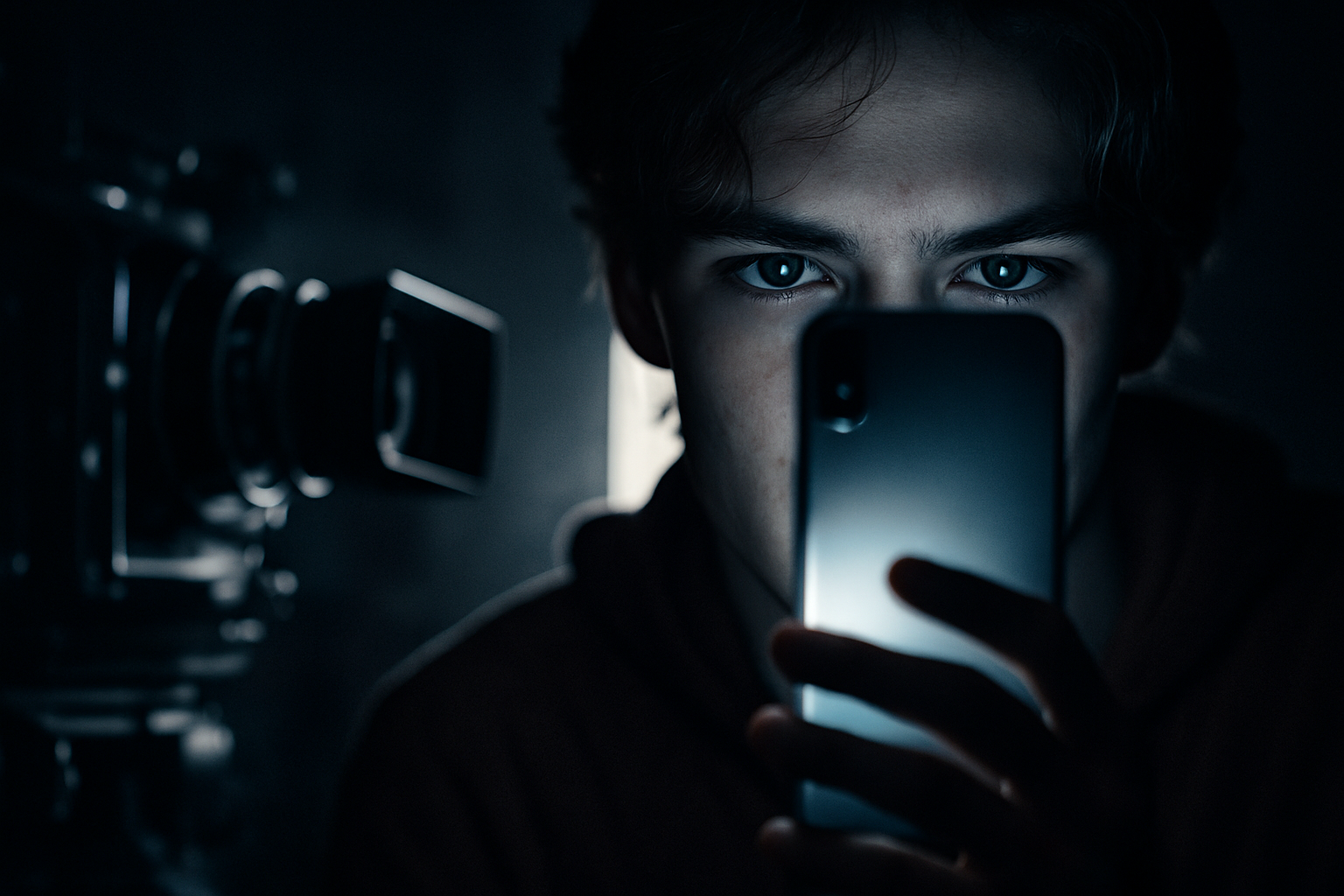
If social media changed how performers are discovered, the self-tape changed how they are evaluated, and the two trends fused during the COVID-19 pandemic. When in-person auditions became impossible in 2020, the self-tape — an actor recording their own audition and uploading it — went from a common practice to the default. Overnight, the audition became a piece of content produced at home and transmitted digitally.

That normalization had a lasting effect. Once the industry accepted that a performance filmed on a phone in a bedroom could be the basis for a casting decision, the conceptual distance between a self-tape and a TikTok collapsed. A creator who has spent years shooting, lighting, performing to, and editing for a camera in their own home has, in effect, been rehearsing the exact skill set the modern digital audition demands. The performer who is fluent in speaking directly to a lens — holding attention, hitting a beat, conveying character in seconds — arrives with a native advantage in a casting ecosystem that increasingly asks for exactly that.
Agencies Move In: Signing the Feed
The clearest signal that Hollywood decided to take social talent seriously came from the agencies. The major talent representation firms — WME, UTA, CAA — moved aggressively to sign creators whose primary fame originated on TikTok, Instagram, and YouTube, treating them not as novelty acts but as clients with careers to be built across music, television, film, and endorsements.
The D’Amelio sisters are a defining case. As reported by The Hollywood Reporter, TikTok stars Charli and Dixie D’Amelio signed with United Talent Agency, formalizing representation for two performers whose fame had been generated almost entirely through short-form video. Charli D’Amelio, who became one of the most-followed people on TikTok, went on to a Hulu reality series, The D’Amelio Show, and a run on Dancing with the Stars — a trajectory that would have been unimaginable without the agency infrastructure that decided her audience was worth representing.
Addison Rae, another TikTok breakout, followed a parallel path through the agency system, using representation to convert a follower base into acting and music opportunities. The pattern repeated across the creator economy: agencies built dedicated divisions and strategies for digital talent, recognizing that a client who arrives with tens of millions of followers offers something a traditional newcomer cannot — a guaranteed, portable audience.
When the Feed Becomes the Screen: Real Crossovers
The proof of the model is in the performers who have actually made the jump from feed to screen. Noah Beck offers an instructive example. Beck built an enormous TikTok following — as Yahoo Entertainment bluntly summarized it, he “made a name for himself posting thirst traps on TikTok” — before stepping into acting. He landed the lead in the teen romance Sidelined: The QB and Me, a project rooted in the Wattpad-and-social ecosystem, and, as Variety reported in 2024, he used the moment to argue for himself as an actor rather than a novelty. Speaking to Collider, Beck said he “wanted to prove it was my acting” that earned the role — a telling admission that crossing over means being judged against, and often in spite of, the following that opened the door.
Beck’s careful framing captures the tension at the heart of this entire phenomenon. A large audience gets a creator into the room and gives a producer a commercial reason to bet on them. But once inside, the creator faces the same scrutiny — and often sharper skepticism — than any drama-school graduate. The follower count is the invitation; it is not the performance.
The Micro-Influencer Angle
Not every social-to-screen story involves eight-figure follower counts. The rise of the micro-influencer — a creator with a smaller but highly engaged and specific audience — has given casting a new kind of value proposition. For a project targeting a particular niche, a performer with a devoted community of a few hundred thousand can be more useful than a generalist with millions of passive followers. Engagement, authenticity, and audience fit have become part of the calculus, not just raw scale. Bess Fifer’s point about seeking an “out-of-the-box idea” for a role speaks to this: sometimes the right built-in following is the specific one, not the biggest one.
This is also why casting directors remain adamant that craft cannot be skipped. A niche audience may earn a creator an audition, but the roles that turn a viral moment into a durable career still go to those who can deliver a performance. The micro-influencer path rewards those who treat social media as a place to demonstrate ability, not merely to accumulate numbers.
Conclusion: A New Door, Not a New Rulebook
The casting call has genuinely changed. A performer’s social feed is now a formal part of their professional profile, agencies have built entire strategies around signing digital talent, the self-tape has erased the line between an audition and a piece of content, and creators like Noah Beck and the D’Amelios have proven the crossover is real. Follower counts, at the highest commercial tier, can tip a decision.
But the people who actually make casting decisions keep returning to the same point: numbers get you noticed, not hired. Julie Schubert, Tiffany Little Canfield, and Bess Fifer — casting directors on some of the most prestigious projects in television — all insist that craft, training, and the ability to hold a moment on camera remain the currency that matters. Social media has built a new door into Hollywood, wider and more accessible than the old one. What happens once a performer walks through it is governed by rules as old as the industry itself.