

For most of its history, Broadway sold itself through a familiar liturgy: the New York Times review, the Tony Awards telecast, the marquee outside the theater, and the full-page newspaper ad. That machinery still exists. But over the past several years, an industry famous for tradition has been quietly rebuilt around a new proposition — that a teenager filming herself in the mezzanine, or a TikTok sound clipped from Act One, can move tickets more efficiently than a critic’s rave. This is the story of how Broadway learned to think like a social-media marketer, and of one widely repeated statistic that deserves careful scrutiny.
A Claim Worth Interrogating
The premise often cited is arresting in its precision: that roughly one million social-media impressions can lift ticket sales by about 24 percent. It is the kind of clean, quotable figure that circulates through marketing decks and trade panels. Before building an argument on it, honesty requires a disclosure: an extensive search of industry and academic sources did not surface a verifiable primary study establishing that specific “one million impressions equals a 24 percent lift” relationship. It appears to be the sort of figure that gets repeated more often than it gets sourced.
That matters, because Broadway’s own marketing veterans have long warned that the impression-to-ticket link is notoriously hard to measure. As far back as 2016, Forbes contributor Lee Seymour, analyzing the sector’s social data, concluded bluntly that raw tweet volume and ticket sales were not reliably correlated — “the problem isn’t generating sales,” he wrote, “it’s tracking them.” A Goldstar survey he cited found that among social-media users, 92 percent wanted to learn more about an event when a friend bought a ticket, and 66 percent of those went on to buy — evidence that social influence is real, but that it operates through peer trust rather than sheer impression counts. So while the 24 percent figure should be treated as unverified marketing lore rather than established fact, the underlying claim — that social virality now demonstrably drives Broadway box office — is supported by a growing pile of concrete cases.
The Beetlejuice Precedent
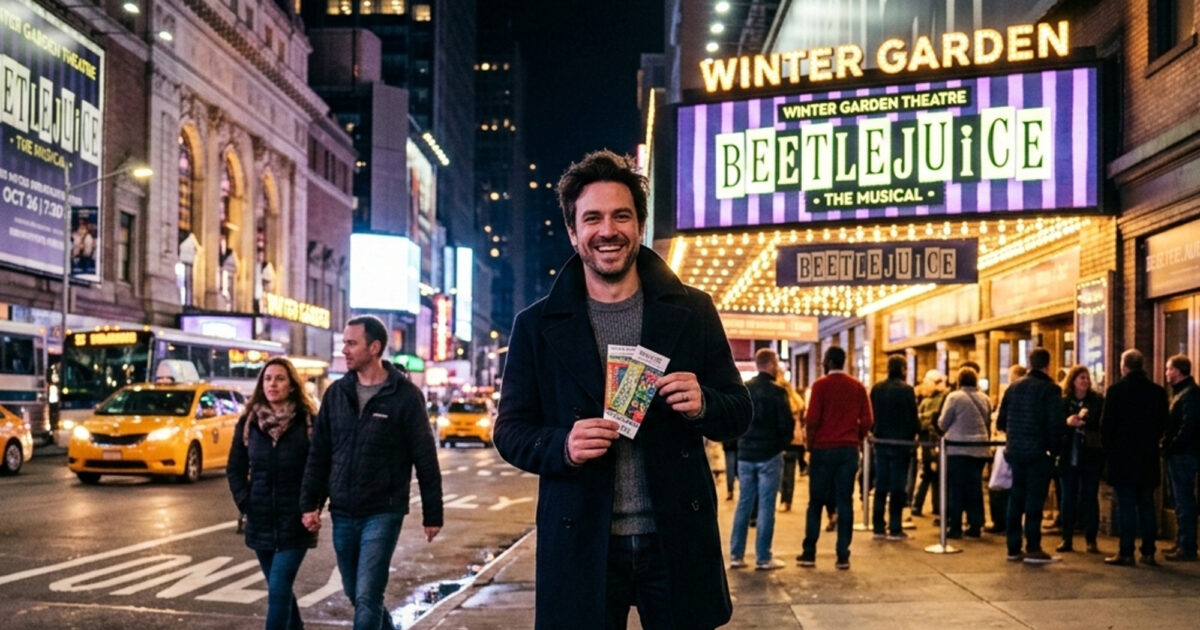
The show that convinced skeptics was Beetlejuice. When the musical adaptation of Tim Burton’s film opened in 2019, critics were lukewarm and its commercial future looked uncertain. Then teenagers on TikTok adopted it. Songs including “The Whole Being Dead Thing,” “Say My Name,” “Dead Mom,” and “What I Know Now” became viral sounds, soundtracking millions of user videos. According to reporting by Rolling Stone, the hashtag #BeetlejuiceMusical surpassed 43.6 million uses, a clip of the Tony Awards performance drew more than 2.5 million views on YouTube, and the cast album became the top-streaming original Broadway recording of its season.

The audience data told the real story. Rolling Stone reported that roughly 54.95 percent of Beetlejuice‘s ticket buyers were first-time Broadway attendees, and the crowd skewed dramatically younger than the industry norm — well above the typical benchmark for the 19-to-54 age band. Composer Eddie Perfect captured the phenomenon: “When TikTok started to vibe with it, that’s when things got insane.” A show the critical establishment had written off found a second life not through revised reviews but through a demographic the reviews never reached.
Six, & Juliet, and the New Grammar of the Musical
Beetlejuice was not an anomaly; it was the template. Six, the pop-concert retelling of Henry VIII’s wives, built a devoted following on TikTok, where its bangers — “Ex-Wives” and the queens’ individual anthems — became endlessly clipped, covered, and lip-synced. The show’s structure, a series of self-contained, hook-driven numbers, is almost purpose-built for a platform that rewards fifteen-second emotional payoffs. That is the deeper shift: producers now greenlight and stage work with an eye toward “clippability,” designing moments engineered to detach from the show and travel on their own.
& Juliet, the jukebox musical built on the songbook of pop producer Max Martin, extended the strategy in a different direction — by importing a creator directly into the cast. When TikTok superstar Charli D’Amelio, once the most-followed person on the platform, joined the ensemble on an open-ended contract, the show recorded the highest-grossing week of its run during her tenure, according to reporting collected by BroadwayWorld. The casting was, transparently, a marketing instrument as much as an artistic one.
When the Strategy Works — and When It Doesn’t
The most useful data comes from cases where influencer casting produced measurable box-office movement. The clearest example predates the TikTok era slightly: in the fall of 2019, YouTube star Colleen Ballinger, known for her Miranda Sings persona and roughly 20 million combined subscribers, joined Waitress for a four-week run. According to BroadwayWorld’s reporting, the show’s weekly grosses jumped from around $600,000 to more than $900,000 during her stint, with two weeks selling out standing-room-only. A 50 percent grosses increase, driven by an internet celebrity with no prior Broadway pedigree, is close to a controlled experiment in influencer value.
But Broadway has also learned that the tactic is not automatic. In January 2020, social-media personality Cameron Dallas joined Mean Girls for a limited run; BroadwayWorld noted that grosses actually dipped during his tenure and the reception was poor. The contrast with Ballinger is the whole lesson: audience fit, credible fit between the creator and the material, and genuine performing ability matter more than raw follower counts. A star whose audience does not overlap with theatergoers, or who cannot deliver on stage, imports risk rather than revenue. The 2025 casting of Trisha Paytas — a creator with more than 10 million TikTok followers — in Beetlejuice extended the experiment into a new season, testing again whether follower scale converts to seats.
The Agencies Building the Machine
Behind these campaigns sits an increasingly sophisticated marketing infrastructure. The digital and advertising agencies that specialize in Broadway — including SpotCo, Serino Coyne, Marathon Digital, and Situation — now treat influencer and social strategy as core business rather than an afterthought. Executives such as SpotCo’s Kristen Rathbun, Marathon Digital’s founder Mike Karns, and Serino Coyne’s Diana Salameh, its vice president of brand integration, have publicly discussed how the industry integrates creators into launch plans. The macro backdrop explains the urgency: the broader influencer-marketing industry ballooned from an estimated $1.7 billion in 2016 to figures in the range of $21 billion by 2023, and survey data cited across the trade press suggests that a majority of social-media users — around 53 percent in some studies — have purchased a product after seeing an influencer post about it.

Broadway’s landlords and producing organizations, chiefly the Shubert and Nederlander organizations and the former Jujamcyn theaters (now merged with ATG), have correspondingly leaned into data-driven digital ticketing, dynamic pricing, and audience-development strategies aimed squarely at younger, social-native buyers. The strategic logic is demographic survival: the tourist and subscriber base that historically sustained Broadway is aging, and TikTok is where the next generation of theatergoers is being recruited.
What the Evidence Actually Supports
Strip away the unverified 24 percent headline, and a defensible picture remains. Social virality demonstrably widens the top of the funnel, pulling in first-time and younger buyers — as the Beetlejuice audience data shows. Influencer casting can produce dramatic, measurable grosses spikes when the fit is right, as Waitress and & Juliet demonstrate, and can underperform when it isn’t, as Mean Girls did. And the industry’s marketing establishment has restructured itself around these realities, hiring for social fluency and designing shows to be clipped.
What the honest analyst cannot do is attach a single, universal conversion multiple to an impression count. The relationship between reach and revenue on Broadway is real but contingent — mediated by audience fit, peer trust, and whether the viral moment actually makes someone want to sit in a $150 seat. Broadway’s record-breaking recent seasons, which pushed grosses to new highs, were built on many forces, but the reinvention of its marketing around creators and short-form video is unmistakably one of them. The lesson for producers is not to chase impressions for their own sake, but to engineer the kind of authentic, clippable, community-driven moment that turns a scroll into a ticket.